Unattended SSH with Smartcard

I have several backup servers that run the excellent rsnapshot software, which uses Secure Shell (SSH) for remote access. The SSH private key of the backup server can be a weak link in the overall security. To see how it can be a problem, consider if someone breaks into your backup server and manages to copy your SSH private key, they will now have the ability to login to all machines that you take backups off (and that should be all of your machines, right?).

The traditional way to mitigate SSH private key theft is by password protecting the private key. This works poorly in an unattended server environment because either the decryption password needs to be stored in disk (where the attacker can read it) or the decrypted private key has to be available in decrypted form in memory (where attacker can read it).

A better way to deal with the problem is to move the SSH private key to a smartcard. The idea is that the private key cannot be copied by an attacker who roots your backup server. (Careful readers may have spotted a flaw here, and I need to explain one weakness with my solution: an attacker will still be able to login to all your systems by going through your backup server, however it will require an open inbound network connection to your backup server and the attacker will never know what your private key is. What this does is to allow you to more easily do damage control by removing the smartcard from the backup server.)

In this writeup, I’ll explain how to accomplish all this on a Debian/Ubuntu-system using a OpenPGP smartcard, a Gemalto USB Shell Token v2 with gpg-agent/scdaemon from GnuPG together with OpenSSH.

Continue reading Unattended SSH with Smartcard
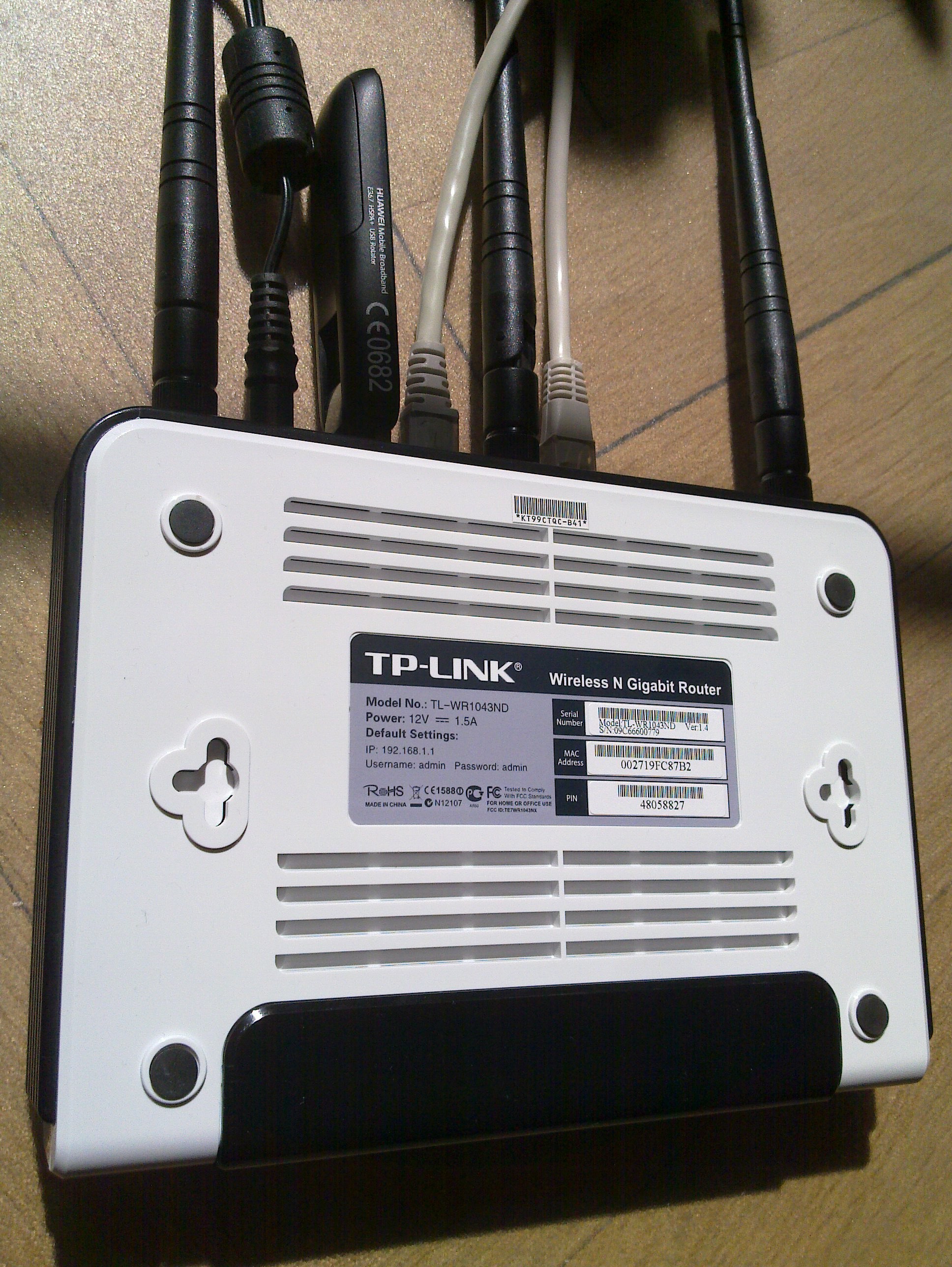
OpenWRT with Huawei E367 and TP-Link TL-WR1043ND

The ability to connect a 3G modem to a wireless router to form a Internet connected ad-hoc network of machines is very powerful. I’ve done this many times and have written about it before (e.g., see my OpenWRT writeup page) but I recently did it with modern hardware again. Here I will use the TP-Link TL-WR1043ND wireless router (available here for around $50) together with the Huawei E367 3G UMTS/HSDPA modem. Other wireless routers and modem should work fine. The software is OpenWRT 10.03 although I hope to redo this with LibreWRT eventually. My writeup is mostly focused around what is happening around the prompt, so it is mostly a cut’n’paste terminal session with a comment interlined.

TL-WR1043ND and Huawei 367
Router and modem

Continue reading OpenWRT with Huawei E367 and TP-Link TL-WR1043ND

Introducing the OATH Toolkit

I am happy to announce a project that I have been working quietly on for about a year: the OATH Toolkit. OATH stands for Open AuTHentication and is an organization that specify standards around authentication. That is a pretty broad focus, but practically it has translated into work on specifying standards around deploying and using electronic token based user authentication such as the YubiKey.

YubiKey

OATH’s most visible specification has been the HOTP algorithm which is a way to generate event-based one-time passwords from a shared secret using HMAC-SHA1. HOTP has been published through the IETF as RFC 4226. Built on top of HOTP is the time-based variant called TOTP, which requires a clock in the token. OATH do some other work too, like specifying a data format for transferring the token configuration data (e.g., serial number and shared secret) called PSKC.
Continue reading Introducing the OATH Toolkit

On Password Hashing and RFC 6070

The RFC Editor has announced a new document, RFC 6070, with test vectors for PKCS5 PBKDF2. The document grow out of my implementation of SCRAM for GNU SASL. During interop testing, more than one other implementation turned out to have mistakes in the PBKDF2 implementation. It didn’t help that there weren’t any stable test vectors for PBKDF2, so that we could do black-box testing of our PBKDF2 implementations against well-known and stable test vectors. Debugging this was time consuming. The document addresses this problem.

So what is PBKDF2?
Continue reading On Password Hashing and RFC 6070

GNU SASL with SCRAM-SHA-1-PLUS

I have finished the SCRAM implementation in GNU SASL. The remaining feature to be added were support for the “enhanced” SCRAM-SHA-1-PLUS variant instead of just the normal SCRAM-SHA-1 mechanism. The difference is that the latter supports channel bindings to TLS, which makes it possible to detect man-in-the-middle attacks even if TLS is not used with server authentication. In GnuTLS we recently added an API for applications to extract channel bindings, which you will need to use in order to use SCRAM-SHA-1-PLUS. I announced the experimental version 1.5.4 release together with a writeup on how to test it. With this, our support for SCRAM should be complete.